What if the traditional pyrotechnic flare in your locker is actually the biggest safety risk on your boat? For many UK boaters, managing distress signals feels like a constant battle against expiring shelf lives and the increasing difficulty of finding legal disposal points. You likely recognise that having a reliable way to call for help is non-negotiable, yet the prospect of handling volatile pyrotechnics or navigating the latest MCA guidance on electronic alternatives can be daunting. It is a complex balance to strike between meeting legal requirements and ensuring practical, hands-on safety for your crew.
This guide will help you master the technical nuances of both pyrotechnic and electronic flares, ensuring your vessel remains fully compliant whilst keeping everyone on board protected. We will provide a clear breakdown of the equipment needed for your specific sailing area, compare the operational life of LED devices against traditional rockets, and offer practical solutions for the safe storage and disposal of your kit. By the end of this article, you will have the confidence to build a distress signal strategy that is both legally sound and technically superior.
Key Takeaways
- Understand why visual signals remain essential for pinpointing your location during the "last mile" of a rescue, even with modern GPS and VHF systems.
- Compare the technical nuances of traditional pyrotechnics and modern LED flares to determine which technology best suits your crew's safety requirements.
- Identify the correct distress signal pack for your specific cruising grounds, ranging from inshore handhelds to offshore parachute rockets.
- Master the legalities of safe disposal in the UK and learn how to store pyrotechnics correctly to prevent degradation and accidental ignition.
- Gain professional insights into integrating your distress signals with broader marine hardware to create a robust and compliant safety kit.
The Vital Role of Marine Flares in Modern Vessel Safety
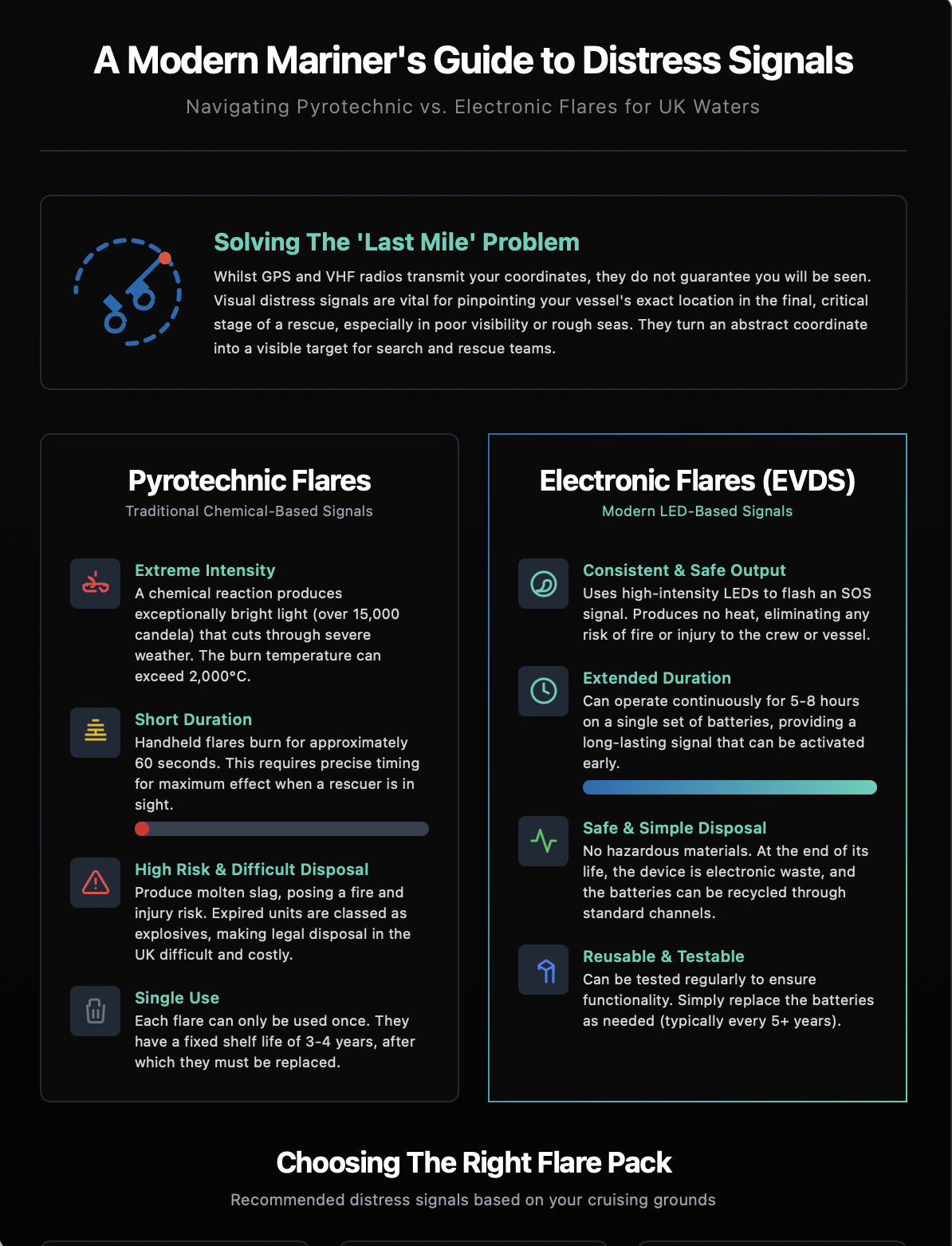
Marine flares are specialised distress signals, available in both pyrotechnic and electronic forms, designed to provide a precise visual location for a vessel in trouble. While modern electronics like EPIRBs and DSC-enabled VHF radios are excellent at transmitting coordinates, they often leave a gap known as the 'last mile' problem. A rescue craft might arrive at the exact GPS coordinates only to find that sea state, darkness, or mist makes spotting a small boat nearly impossible. This is where these tools become indispensable. They offer a high-intensity visual target that cuts through environmental interference, providing immediate confirmation to search and rescue (SAR) teams.
The Maritime and Coastguard Agency (MCA) continues to mandate the carriage of visual distress signals for most commercial and large pleasure vessels in the UK. Even for smaller recreational craft, the RYA strongly recommends them. Beyond the legalities, there is a significant psychological benefit. In high-stress situations, seeing a signal ignite provides the crew with a sense of active participation in their own rescue, whilst offering rescuers a clear beacon to steer towards. It transforms an abstract coordinate on a screen into a tangible, visible objective.
Why Flares Remain Essential in the Digital Age
In an era of satellite-linked safety gear, the humble flare might seem antiquated, but its reliability is unmatched. Pyrotechnic versions require no battery power and are immune to the electronic interference that can plague digital systems in heavy weather. For search teams, particularly helicopter pilots and RNLI lifeboat crews, these signals provide the final visual lock-on needed to begin a recovery. The international standards governing the history and types of flaresensure that these devices are universally recognised by any mariner or rescue professional, regardless of their nationality or the technology on their bridge.
The Distinction Between Signalling and Illumination
Effective maritime communication requires using the correct tool for the specific threat. Red pyrotechnics are the primary signal for grave and imminent danger, indicating that a vessel requires immediate assistance. In contrast, white versions are used for illumination and collision avoidance; they warn other vessels of your presence if a risk of impact is detected. For daytime emergencies, orange smoke is the preferred choice. These canisters produce a dense, persistent cloud that is far more visible against the glare of the sun than a light-based signal, particularly in low-wind conditions where the smoke can linger to mark a position.
Pyrotechnic vs. Electronic Flares: Understanding the Technology
Choosing between traditional pyrotechnics and modern electronic visual distress signals (EVDS) requires a clear understanding of the physics behind each. Pyrotechnic flares rely on a high-temperature chemical reaction involving magnesium for intense white light and strontium salts to produce the characteristic red distress hue. These materials burn at temperatures often exceeding 2,000°C. While this creates an incredibly bright signal, it also produces "slag", which is a molten residue that can burn through deck surfaces or cause severe injury to the operator if not handled with precision.
In contrast, the rise of EVDS has introduced high-intensity LED technology to the maritime market. These devices pulse light in specific SOS patterns and, unlike their chemical counterparts, they produce no heat and carry zero fire risk. When comparing Pyrotechnic vs. Electronic Flares, the primary trade-off is between the raw, piercing intensity of a chemical burn and the sustained duration of an LED signal. A standard red handheld pyrotechnic burns for approximately 60 seconds; an EVDS device can pulse for five to eight hours on a single set of batteries.
If you are looking to update your vessel's safety kit, you can find a range of professional-grade marine and yacht parts and equipment at Promarine Store.
Traditional Pyrotechnic Flares
- Handheld Red Flares: These provide a high-intensity output, often exceeding 15,000 candela, making them the gold standard for night-time pinpointing during the final stages of a rescue.
- Parachute Rocket Flares: Designed for long-range visibility, these rockets reach altitudes of 300m and can be seen from up to 28 miles away in clear conditions.
- Buoyant Orange Smoke: These are essential for daytime rescue operations, particularly when helicopters are involved, as they provide a clear indication of wind direction and vessel position.
It's vital for professional sailors to distinguish between these SOLAS-approved tools and unregulated "toy" smoke products. Genuine marine-grade pyrotechnics are engineered to function in extreme salt-water environments where cheaper alternatives will fail.
Electronic LED Flares (EVDS)
The safety benefits of electronic options are significant. Because they don't rely on combustion, they are safe to use in environments where petrol vapours or gas leaks might be present. Their operational life is another major advantage; replaceable batteries allow for continuous signalling for several hours, which is a massive leap over the one-minute burn time of a handheld rocket. In the UK, the legal status of EVDS is evolving. Whilst they are currently recognised as excellent supplementary equipment, they don't yet fully replace the requirement for parachute rockets on vessels where carriage is mandatory under MCA regulations.
Choosing the Right Flare Pack for Your Sailing Category
Selecting the correct distress signal kit depends entirely on your cruising profile. Whether you are navigating sheltered inland waterways or crossing the English Channel, your choice of flares must reflect your distance from the shore and the likely response time of rescue services. A mismatched kit either leaves you under-equipped in an emergency or burdened with specialised hardware that exceeds your operational needs. In the UK, safety packs are categorised by the environment they are intended for, ensuring that the light intensity and altitude of the signals match the search area.
The Inshore Pack is the baseline for those in sheltered waters, focusing on handheld signals and smoke for close-proximity rescue. As you move further out, the Coastal Pack introduces parachute rockets to bridge the gap between the vessel and coastal lookouts. For those undertaking serious voyages, the Offshore or Ocean Pack is the professional standard. These kits provide maximum redundancy and utilise SOLAS-approved hardware designed to withstand the violent motion and heavy spray of open-water environments. At Promarine Store, we provide these tiered solutions to ensure your safety kit is proportionate to your vessel's range.
Inshore and Narrowboat Requirements
For river and canal users, daytime visibility is the primary concern. In these crowded environments, buoyant orange smoke is often more effective than a rocket, as it provides a persistent marker amongst river traffic without the risk of landing on nearby property. Storage is frequently a challenge on smaller vessels; using compact, waterproof poly bottles helps protect your equipment from damp lockers. On inland waterways, carrying a white collision flare is often more practical than a red rocket, as it allows you to warn oncoming vessels in tight channels or low-visibility bends.
Offshore and Blue Water Cruising
Venturing beyond the seven-mile mark necessitates a shift to SOLAS-grade pyrotechnics. These are engineered to higher manufacturing standards, offering better resistance to vibration and salt-spray than cheaper alternatives. Redundancy is the cornerstone of offshore safety. A smart strategy involves combining the long-term duration of an EVDS device with the high-altitude reach of parachute rockets. This "belt and braces" approach ensures you can trigger an initial alert that is visible from 28 miles away, whilst maintaining a pulsing signal for several hours to guide rescuers to your exact position during the final approach.
Safe Handling, Storage, and Legal Disposal in the UK
Managing pyrotechnics involves more than just purchasing the correct pack; it requires a disciplined approach to storage and a clear plan for eventual decommissioning. The industry standard for the chemical stability of flares is typically three to four years. Beyond this date, the internal compounds can degrade, leading to unpredictable ignition or a complete failure to fire. Because these devices are classified as explosives, they cannot be discarded in household waste, nor can they be fired off to celebrate New Year or other non-emergency events. Doing so is a criminal offence that can lead to significant fines and the unnecessary diversion of search and rescue resources.
Safe storage is essential to prevent accidental ignition and to ensure the hardware remains functional when needed. Pyrotechnics should be kept in dedicated, waterproof "poly bottles" to shield them from the corrosive effects of salt air and damp lockers. These containers must be stored in a cool, dry location away from engines, heaters, or any other heat sources. When handling a live flare, always wear heavy-duty gloves and hold the device downwind and away from your body. This protects you from the intense heat and the "slag", which is the molten residue that can drip from the casing during combustion.
For those looking to refresh their safety equipment with reliable, professional-grade hardware, you can browse our full range of marine and yacht parts and equipment at Promarine Store.
How to Legally Dispose of Expired Flares
The UK is currently facing a "disposal crisis" as many traditional collection points have closed. Most marinas, police stations, and fire stations no longer accept Time Expired Pyrotechnics (TEP) due to strict health and safety regulations. The responsibility for safe disposal rests entirely with the boat owner. You must use specialised TEP disposal contractors or check for designated Maritime and Coastguard Agency (MCA) drop-off days. Some specialist chandleries offer a "buy new, trade old" scheme, where they will accept your expired units for a small fee when you purchase a replacement kit, which is often the most convenient solution for leisure sailors.
Emergency Procedures: Training Your Crew
In a high-stress distress situation, there is no time to read instructions. The skipper must ensure that every crew member is shown the exact location of the safety kit and briefed on its operation immediately upon boarding. For practical training, using expired but safe electronic flares is an excellent way to conduct simulated drills without the risks associated with live pyrotechnics. Ensure your crew understands the difference between pull-wire and strike-cap activation mechanisms, as the physical force required to trigger them can vary significantly between brands and models.
Equipping Your Vessel with Professional-Grade Safety Hardware
Building a dependable safety inventory requires more than just buying the first pack of flaresyou see. It involves a systematic evaluation of how your equipment works together under pressure. A holistic safety audit, performed during your vessel's winterisation or spring fit-out, is the ideal time to check for chemical degradation in pyrotechnics and battery health in electronics. This process ensures that when you reach for a distress signal, it functions exactly as intended. At Promarine Store, we advocate for a solution-oriented approach where every piece of hardware, from shackles to signalling devices, is selected for its technical reliability in the harsh UK maritime environment.
Integrating your distress signals with other essential hardware is a mark of a well-found vessel. For instance, ensuring your fire blankets are easily accessible alongside your pyrotechnics creates a centralised safety station. High-quality marine hardware, such as load-tested shackles and professional-grade boat parts, plays a preventative role. By maintaining the structural integrity of your rigging and ground tackle, you significantly reduce the likelihood of the gear failures that lead to distress situations in the first place. Expert consultation is often the difference between a compliant boat and a truly safe one; our team provides the guidance needed to tailor your kit to your specific sailing category.
The Promarine Approach to Maritime Safety
Our curated selection focuses on industry-proven hardware that meets strict SOLAS and MCA standards. We intentionally avoid the "Amazon trap" of unverified, non-compliant safety gear that often fails under the rigours of salt-spray and vibration. Our technical support simplifies the transition to modern LED systems, offering a faff-free way to upgrade your signalling capabilities whilst maintaining compliance. With our national delivery service, we ensure that professional-grade safety equipment reaches your berth anywhere in the UK, providing peace of mind regardless of your home port.
Beyond Flares: Building a Robust Safety Kit
A robust safety kit is defined by its standardisation and ease of use. Clear labelling and colour-coding allow crew members to identify tools instantly in low-visibility or high-stress conditions. Whilst flares are the final line of communication, your primary safety strategy should rely on the durability and efficiency of your on-board systems. By investing in professional marine and yacht parts, you ensure that your vessel remains a secure platform for all your adventures.
Browse our complete range of marine safety and hardware to ensure your vessel is fully prepared for the season ahead.
Securing Your Vessel for Every Voyage
Ensuring your vessel is equipped with the correct distress signals is a fundamental aspect of responsible seamanship. By balancing the high-altitude reach of pyrotechnic rockets with the sustained operational life of modern LED flares, you create a layered communication system that works in all conditions. Remember that safety isn't a static requirement; it demands regular audits of your equipment's expiry dates and a clear understanding of the latest MCA guidance to remain compliant in UK waters.
As expert UK chandlery specialists, Promarine Store provides the technical hardware and consultative advice you need to navigate these choices. We offer a curated range of professional-grade safety equipment and provide nationwide delivery to ensure you have access to the best tools regardless of your home port. Investing in reliable, industry-proven hardware is the most effective way to protect your crew and gain peace of mind on the water.
Shop SOLAS-approved flares and marine safety gear at Promarine Store
With the right preparation and the correct equipment in your lockers, you can head out on your next adventure with total confidence.
Frequently Asked Questions
Are marine flares legally required on all boats in the UK?
Marine flares are a legal requirement for all commercial vessels and pleasure craft over 13.7 metres in length, categorised as Class XII vessels under UK law. For pleasure vessels under 13.7 metres, there is no strict legal mandate to carry them, though the RYA and MCA strongly recommend a visual signalling kit for all coastal voyages. It is essential to check the specific regulations for your vessel's class and sailing area to ensure you meet the minimum safety standards.
Can I use LED electronic flares instead of traditional pyrotechnics?
Electronic LED versions are legal to carry in the UK, but they are not yet recognised as a full substitute for pyrotechnic flares on vessels where carriage is mandatory. They are widely regarded as exceptional supplementary equipment due to their long operational life and safety benefits. However, if your vessel is over 13.7 metres, you must still carry the required number of parachute rockets and handheld signals to meet Merchant Shipping regulations.
How do I dispose of old flares in the UK without getting a fine?
You must use a registered Time Expired Pyrotechnics (TEP) disposal contractor or attend a designated Maritime and Coastguard Agency drop-off event to dispose of your kit safely. It is a criminal offence to discard them in household waste, at a local tip, or to set them off in a non-emergency situation. Many specialist chandleries offer a disposal service for a fee when you purchase replacement kits, which is often the most reliable route for leisure sailors.
What is the difference between red, white, and orange flares?
Red signals indicate grave and imminent danger and are used to request immediate assistance from rescue services. White signals are specifically for collision avoidance and illumination, helping you warn other vessels of your position if a risk of impact is detected. Orange smoke is a daytime-specific signal designed to provide a persistent visual marker that is easily spotted by rescue aircraft and helps rescuers determine wind direction during a recovery.
How long do marine flares actually last before they expire?
Pyrotechnic flares typically have a shelf life of three to four years from the date of manufacture. After this period, the chemical compounds can degrade, which leads to a risk of misfiring or unpredictable ignition. You should check the expiry dates during your annual safety audit and replace any units that are approaching their end of life to ensure your distress signals remain dependable when they are needed most.
Can I take marine flares on a plane or transport them by standard courier?
No, you cannot transport pyrotechnic signals on a plane or via standard postal and courier services. Because they are classified as Class 1 explosives, they require specialist ADR (Dangerous Goods) transport by law. If you need to move them, you must use a courier certified for hazardous materials. Most retailers use these dedicated networks to deliver safety gear directly to your berth or home address.
Are photography smoke grenades the same as marine smoke flares?